
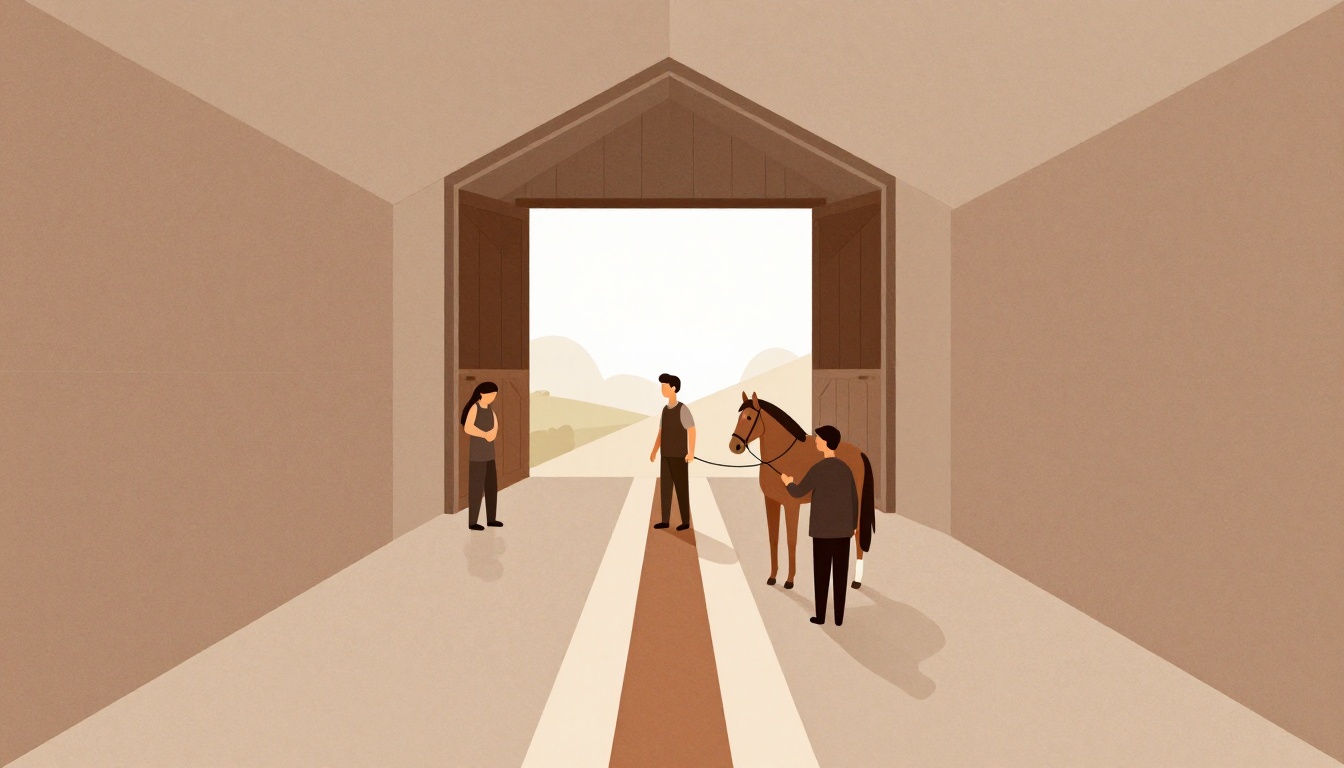
What is the commonly recommended minimum aisle width for safe horse-and-handler movement in a barn?
Select one answer.
Why shared barns create handling hazards
In a shared barn, multiple boarders, staff, and visitors move horses through the same aisle every day. That overlap is where most ground-handling accidents start: a horse is led past a handler standing in a blind spot, a wheelbarrow blocks the only exit, or a wet wash stall turns into a slip hazard. The fix is not more rules for their own sake — it is designing and enforcing clear handling zones so horses and people always have room to move and get out of the way.
Start with the aisle: width, height, and footing
The aisle is the spine of the barn and the highest-traffic zone. Industry guidance consistently recommends a minimum aisle width of 12 feet for safe horse-and-handler movement, cross-tying, and passage of equipment like wheelbarrows; commercial, boarding, or training facilities often benefit from 14 feet or more (American Stalls). Aisle height matters too — plan for at least a 10-foot ceiling above the aisle so a spooking or rearing horse does not strike low beams (Equine Facility Design).
Footing is the other half of aisle safety. Concrete without a surface treatment is slippery when wet, dirt compacts unevenly, and loose rubber mats shift and create trip hazards. Rubber pavers, dry-set or adhered to a concrete underlayment, provide reliable grip for hooves and footwear in both wet and dry conditions (Innovative Equine Systems).
Define the zones
Treat the barn as a set of distinct zones, each with its own rules:
- Traffic lane: the center strip of the aisle, kept clear at all times. No standing, no tack trunks, no hoses.
- Tie and cross-tie zone: a marked area with panic snaps or breakable ties, positioned so a tied horse cannot block the traffic lane.
- Grooming and wash zone: open, well-drained, and located away from the main flow so wet floors do not become a slip hazard in the aisle (Rutgers Equine Science Center).
- Storage zone: dedicated space for tack trunks, wheelbarrows, pitchforks, and blankets so they never migrate into the aisle.
A practical checklist for barn managers
- Measure your aisle. If it is under 12 feet, restrict simultaneous horse traffic to one direction at a time.
- Mark the traffic lane with paint or pavers so the clear path is obvious to everyone.
- Post zone rules at every entrance: where to tie, where to groom, where not to stand.
- Keep hoses coiled on reels and faucets out of the traffic path.
- Pick up manure immediately in cross-tie and grooming areas to prevent slips and trips.
- Require closed-toe boots and, for minors, secure headgear while handling horses.
- Inspect stall fronts, partitions, and aisle walls weekly for loose boards, chewed edges, and exposed nail heads.
- Run a short orientation for every new boarder, leaser, and regular visitor covering the zones and emergency exits.
Handling rules that make zones work
Zones only work if handling habits support them. Approach a horse from the front and speak before touching, because horses have blind spots directly in front and behind. When you stand near a horse, stay close to the body at the shoulder rather than in the kick zone. Never wrap a lead rope around your hand or drape it over your shoulder — a sudden movement can cause serious injury (Horizon Structures).
Review and enforce
A zone plan is only as good as its enforcement. Walk the barn monthly with a written checklist, log any near-misses, and adjust the layout when a pattern appears. Documenting these operational protocols also matters if an incident ever leads to a liability question, because it shows the facility identified hazards and acted on them.
How the Featured Expert Can Help
Randi Thompson is an equine industry expert witness and consultant with over 45 years of experience. She founded the Equine Safety and Success Network (ESSN) and the Equine Safety and Success Guide (ESSG), which focus on safety standards, risk management, and operational protocols for equine facilities. You can learn more at randithompsonlive.com.