
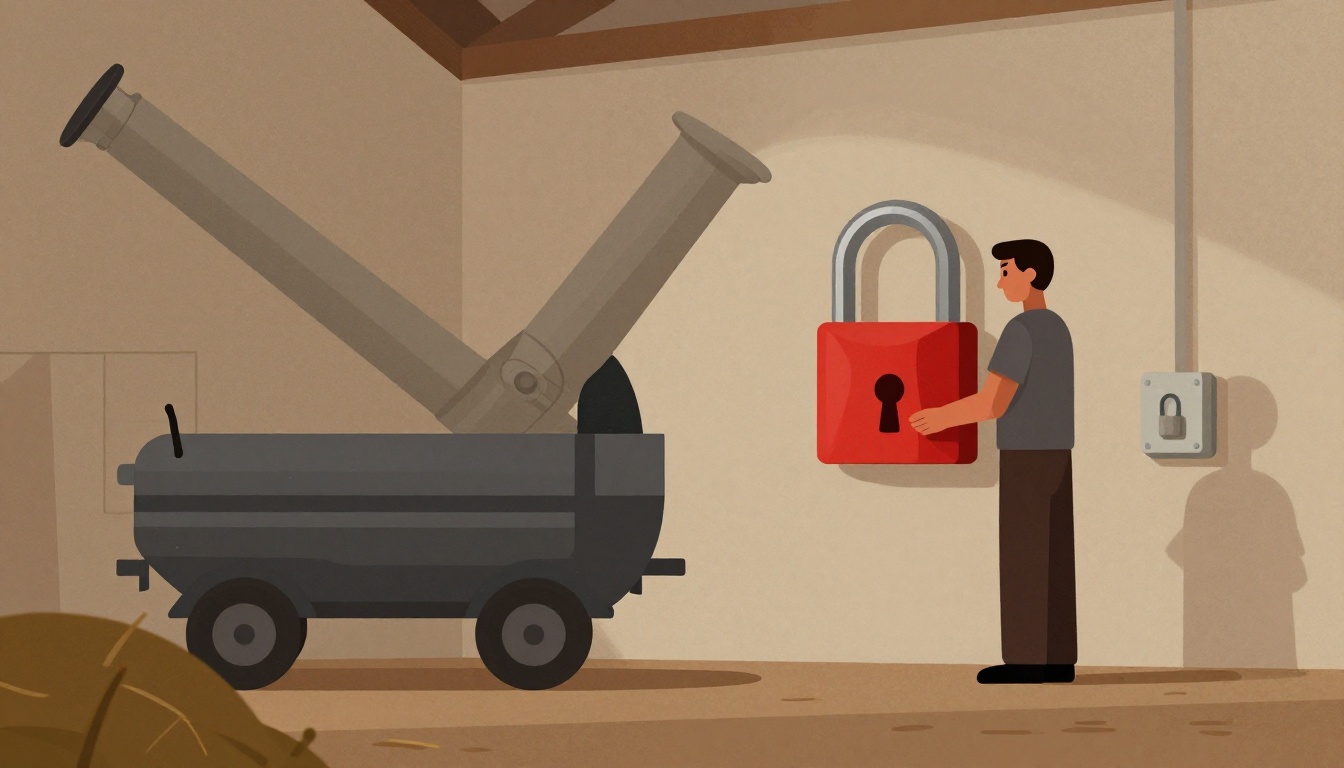
When you reach into a hay baler to clear a jam or climb into a grain bin to unclog an auger, the last thing you want is for someone to accidentally hit the power switch. Lockout/tagout (LOTO) is the safety procedure that prevents exactly that scenario. It ensures machinery is properly shut off and cannot be started again before maintenance or repair work is complete, protecting you and your team from unexpected energy release. While farms may have some exemptions from OSHA's full LOTO standard, the laws of physics don't care about exemptions—stored energy can still cause serious injury or death. Implementing a practical LOTO program is a critical part of your barn's operational protocols.
What is the purpose of lockout/tagout (LOTO) in barn machinery safety?
Select one answer.
What is lockout/tagout?
Lockout/tagout is a procedure used to ensure that machinery and equipment are properly shut off and not able to be started up again prior to the completion of maintenance or repair work. It involves the use of locks and tags to isolate energy sources, preventing the accidental release of hazardous energy that could cause injury to workers. Only authorized personnel can apply and remove these devices, ensuring that equipment remains inoperable until it is safe to resume operation. This procedure is crucial in preventing workplace accidents related to unexpected machinery start-up or energy release. Source: Harvust
LOTO is about effective communication and having procedures in place to prevent accidental startup of equipment during servicing. It removes all doubt and prevents other employees from unintentionally restoring power that can threaten a life or cause irreversible damage. Source: Good Day's Work
Why barn machinery needs LOTO
Barns are full of powered equipment that can cause harm: augers, hay balers, feed mixers, conveyors, and even electric cart dumpers. These machines often have multiple energy sources—electrical, mechanical, hydraulic, pneumatic, chemical, thermal, and gravitational. Simply turning off the power isn't enough; you must also dissipate stored energy. For example, a hydraulic system may hold components in place, and when pressure is released, parts can move unexpectedly. Source: Rural Mutual
Consider the scenario of a grain bin auger. LOTO should be used whenever a person enters a grain bin to perform any service or maintenance, such as unclogging an auger. Source: Penn State Extension The risk is real: a worker inside the bin, and someone outside flips the switch. A lock and tag create a physical barrier that prevents the machine from being turned on.
Step-by-step LOTO procedure for barn equipment
Follow these steps every time you service or repair powered equipment. Adapt them to each machine in your barn.
- Notify all affected workers. Tell everyone that a lockout/tagout is about to begin and that the equipment will be shut down for maintenance.
- Shut down the equipment. Turn off the power at the control panel or switch. For tractors or combines, shut off the engine and remove the key. Source: Iowa State University
- Isolate all energy sources. Disconnect the battery, lock out the battery switch, or close the main electrical disconnect. For PTO-driven equipment, disengage the PTO and wait for the shaft to stop.
- Apply a lock and tag. Use a padlock on the energy-isolating device (e.g., a lockout hasp on a breaker or valve). Attach a tag with your name, date, and reason for the lockout. Each authorized employee should have their own identifiable lock and key. Source: Good Day's Work
- Release stored energy. Bleed off hydraulic pressure, relieve spring tension, and ensure all moving parts have come to a complete stop. For a combine, apply the lockout cylinder stop and secure head locking pins. Source: Iowa State University
- Verify isolation. Attempt to restart the equipment using the normal controls. It should not start. Then return the controls to the "off" position. This step confirms the lockout is effective.
- Perform the maintenance. Only after verification is complete can you safely begin work.
- Remove locks and tags. After work is done, remove your lock and tag. Only the person who applied the lock should remove it. Then notify everyone that the equipment is ready to be re-energized.
Building a LOTO program for your barn
A LOTO program doesn't have to be complex, but it must be documented and trained.
- Inventory equipment. List all machinery that requires LOTO. Include augers, balers, mixers, and any equipment with moving parts or stored energy.
- Develop procedures for each machine. Write down the specific steps to shut down, isolate, and verify each piece of equipment. Post these near the machine.
- Acquire LOTO supplies. Purchase padlocks, hasps, tags, and lockout stations. Ensure each authorized employee has their own lock and key. Source: Good Day's Work
- Train your team. Train all employees on LOTO procedures, including the importance of never removing someone else's lock or attempting to start locked-out equipment. Source: USDA FSIS (Note: This source is for meat processing, but the principle applies universally.)
- Review and update. Before each harvest or busy season, review your LOTO plan with all employees and check your supplies. Source: Good Day's Work
Common mistakes to avoid
- Skipping the verification step. Always try to restart the equipment after locking out. This is the only way to be sure the energy is isolated.
- Using tags alone. Tags are not enough; they can be removed or ignored. Use a physical lock whenever possible.
- Sharing locks. Each authorized employee must have their own lock and key. Sharing creates confusion and risk.
- Forgetting stored energy. Even after power is off, hydraulic or pneumatic systems can hold energy. Bleed them off before working.
Quiz: Test your LOTO knowledge
Before you head to the barn, take this quick quiz to reinforce the key points.
Question: What is the purpose of lockout/tagout (LOTO) in barn machinery safety?
- A. To ensure machinery is properly shut off and cannot be started again before maintenance is complete
- B. To increase the speed of maintenance operations
- C. To replace the need for machine guards
Correct answer: A. LOTO is a safety procedure to prevent accidental startup during servicing, as defined by OSHA and industry best practices.
How the Featured Expert Can Help
Randi Thompson, founder of the Equine Safety and Success Network (ESSN), offers legal and safety consulting services for equine operations. With over 45 years of experience, she helps barn owners and equine professionals evaluate and improve their safety standards, risk management, and operational protocols. To learn more about how Randi can assist you in developing a comprehensive safety program, visit Randi Thompson Live.